
EXEPERT Updates
TRIBE v2, Explained: Meta's Brain-Predicting Foundation Model and the Idea Behind EXEPERT's 3D Brain
Meta's TRIBE v2 predicts how the brain responds to almost anything we see, hear or read. A multi-chapter deep dive into how it works, what it gets right, its limits, and how the TRIBE line of research inspired the 3D brain at the heart of EXEPERT.
 Akmal Alif · 11 October 2026 MYT
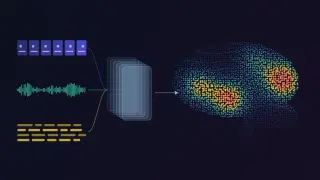
On 26 March 2026 Meta's FAIR lab released TRIBE v2, a model that predicts how the human brain responds to almost anything a person watches, hears or reads. Meta calls it a digital twin of neural activity: show it a film clip, a podcast or a sentence, and it predicts the fMRI activity those stimuli would produce across the brain (Meta AI, 2026a). Meta released the model weights, the code, the paper and an interactive demo.
This is a multi-chapter deep dive. The first seven chapters explain what TRIBE v2 is, how it works, what it can and cannot do, and why neuroscientists care. Chapter 8 is personal: the TRIBE line of research is where the idea for EXEPERT's 3D brain for AI agents came from, and that chapter tells the story. Chapter 9 looks ahead.
Chapter 1: Why predict the brain?
Neuroscience has grown by specialising. One lab studies how we recognise faces, another how we parse sentences, a third how we hear speech in noise. Each builds its own experiment, scans its own volunteers and fits its own model. The TRIBE v2 paper argues that this has left cognitive neuroscience fragmented into specialised models, each tied to one experimental paradigm, with no unified model of cognition (d'Ascoli et al., 2026).
Every new question also needs new brain recordings, which are slow and expensive. An fMRI session means booking a scanner, recruiting volunteers and hours of preprocessing. Meta's demo page frames the problem as a bottleneck that has made brain research slow, costly and hard to scale (Meta AI, 2026b).
An encoding model offers a way around it. Instead of decoding thoughts from brain scans, it goes the other way: given a stimulus, it predicts the brain's response. If the predictions are good enough, researchers can run a first version of an experiment on the model, in silico, before committing scanner time. That is the promise TRIBE v2 makes.
Chapter 2: From TRIBE to TRIBE v2
The first TRIBE, short for TRImodal Brain Encoder, appeared in July 2025 (d'Ascoli et al., 2025). It combined pretrained video, audio and text models to predict whole-brain fMRI responses to films, and it won first place in the Algonauts 2025 brain-encoding competition, out of 263 teams (d'Ascoli et al., 2026).
TRIBE v1 was a competition model. It was trained on low-resolution recordings from four volunteers and predicted about 1,000 cortical parcels (Meta AI, 2026a, 2026b). TRIBE v2 scales it along three axes:
Resolution. Meta describes a 70-fold increase in resolution over comparable models. Its demo page puts the predictions at about 70,000 voxels, against the 1,000 cortical predictions of v1. The released model itself predicts 20,484 points on the cortical surface plus 8,802 voxels in eight subcortical regions (d'Ascoli et al., 2026; Meta AI, 2026b).
Data. Instead of four people, the full dataset covers 720 people and about 1,118 hours of scanning.
Generalisation. The model can predict responses for people, tasks and languages it was never trained on.
Chapter 3: How TRIBE v2 works
Meta's demo describes a three-stage pipeline, and the paper fills in the details (Meta AI, 2026b; d'Ascoli et al., 2026).
Tri-modal encoding. Three frozen, pretrained models turn the stimulus into embeddings. Text goes through Llama-3.2-3B, with each word read in the context of the words before it. Audio goes through Wav2Vec-BERT 2.0. Video goes through V-JEPA 2 Giant, which sees 64 frames covering the previous four seconds. Layers from inside each model are kept, not just the final output.
Universal integration. A Transformer, the part TRIBE actually trains, combines the three streams over time. It learns representations shared across all stimuli, tasks and people. Modality dropout during training teaches it to cope when one input, such as the audio, is missing.
Brain mapping. A subject layer maps those shared representations onto each person's brain: the 20,484 vertices of the standard fsaverage5 cortical surface and 8,802 voxels in eight subcortical regions of the Harvard-Oxford atlas.
The design choice that matters most is the split between the shared Transformer and the per-person mapping. Brains differ in shape and folding, but the paper's results suggest they process the world in similar ways. TRIBE learns the shared part once, from everyone, and keeps only a thin layer for what is individual.
A practical detail from the code: fMRI measures blood flow, which lags neural activity by several seconds, so the released model shifts its predictions five seconds earlier to line up with the stimulus (Meta FAIR, 2026). Text input is first turned into speech and transcribed, so that every word gets a timestamp.
Chapter 4: The data, and a scaling law
TRIBE v2 learns from long recordings of a few people and is tested on short recordings of many (d'Ascoli et al., 2026).
Split | Datasets | People | Hours of fMRI |
|---|---|---|---|
Training | Courtois NeuroMod, BoldMoments, Lebel 2023, Wen 2017 | 25 | 451.6 |
Testing | NNDb, Le Petit Prince, Narratives, HCP 7T | 695 | 666.1 |
Total | Eight datasets | 720 | 1,117.7 |
The training set is deep rather than wide. The Courtois NeuroMod project alone contributes around 269 hours from four of its volunteers, who watched the first six seasons of Friends and four films in the scanner. The test sets are wide: hundreds of people, often with an hour or less each.
The most important finding in this chapter is a scaling law. Encoding accuracy rises log-linearly with the amount of training data, with no plateau in sight (d'Ascoli et al., 2026). Meta's demo draws the obvious conclusion: as more fMRI data becomes available, the model should keep getting better (Meta AI, 2026b). Brain encoding appears to follow the same pattern that made large language models work.
Chapter 5: What it gets right
It beats the classic approach. Neuroscience's standard tool is a linear encoding model, fitted to one person. The paper compares TRIBE v2 with a stronger version of that baseline, a "Deep FIR" model fed with the same modern embeddings, and TRIBE v2 wins on every dataset (d'Ascoli et al., 2026). Meta's summary is a two- to three-fold improvement over standard methods for films and audiobooks (Meta AI, 2026b).
It predicts people it has never seen. In zero-shot tests, the model predicts the average response of a group without any training on those people. On the Human Connectome Project's 7-tesla data, its predictions correlate with the group-average response at about 0.4, twice the score of the median individual subject (d'Ascoli et al., 2026).
Its predictions can beat a real scan. That last result has a striking consequence. Any single fMRI recording is noisy, distorted by heartbeats, head movement and the scanner itself. TRIBE v2 predicts a clean, typical response, so its prediction is often closer to the group average than an actual recording of one person is (Meta AI, 2026b).
It adapts to individuals. With at most an hour of a new person's data, fine-tuning the model for one pass significantly improves how well it models that person (d'Ascoli et al., 2026).
Chapter 6: Neuroscience in silico
The strongest test of a brain model is whether it rediscovers what neuroscience already knows. TRIBE v2 was given the stimuli from classic experiments and its predicted brain activity was analysed as if it came from real volunteers (d'Ascoli et al., 2026).
Vision. Using the visual localiser protocols of the Individual Brain Charting project, the model's predictions light up the fusiform face area for faces, the parahippocampal place area for places, the extrastriate body area for bodies and the visual word form area for written words.
Language. Sentences activate the well-known language network. The predictions also reproduce more specific findings: a stronger left-hemisphere response to sentences than to word lists, and the temporo-parietal junction and middle temporal gyrus for sentences about emotional rather than physical pain.
Integration. Removing one input at a time shows where the brain combines what we see, hear and read. The biggest gains from combining all three, up to 50 per cent, sit at the junction of the temporal, parietal and occipital lobes, with smaller gains in prefrontal cortex.
Meta's demo lists the same families of results: places, bodies, faces, speech, semantics and emotions (Meta AI, 2026b). None of this proves the model understands the brain. It does show that a single model, trained on films and stories, recovers decades of results that each took a dedicated study to establish.
Chapter 7: Limits and caveats
fMRI is slow and indirect. It measures blood oxygen in millimetre-sized voxels over seconds, not the firing of neurons. TRIBE v2 predicts that signal, not neural activity itself, so it inherits fMRI's blurriness in space and time.
The average person. The released model predicts a typical brain response. Individual differences need fine-tuning on that person's own data.
Narrow populations. The volunteers are healthy adults recorded in research scanners. How well the model transfers to children, older adults or people with neurological conditions is still an open question, and those are exactly the groups clinical research cares about.
Prediction is not explanation. A model that predicts brain responses well is a useful instrument, not a theory of how the brain works. The in-silico results are promising because they match known findings; new findings will still need real experiments to confirm.
Non-commercial licence. The weights and code are released under CC BY-NC 4.0, and the text encoder relies on Meta's gated Llama-3.2-3B (Meta FAIR, 2026).
Chapter 8: How the TRIBE line shaped EXEPERT's 3D brain
EXEPERT's first commit, on 4 December 2025, was a 3D brain in the browser: a Three.js scene in which neurons sit on the vertices of a brain mesh, axons join nearby neurons and pulses of light travel along them. TRIBE v1 had appeared that summer, and its central idea stuck: a model can take in a film, a sound or a sentence and predict where in the brain it lands.
That idea shaped what the brain was for. The early app was literally called the META Brain Research Visualizer. Its interface was a "cortical response" dashboard: upload an image or a video as a stimulus, and watch regional activation metrics respond on the brain. It was a product metaphor borrowed from encoding research. A stimulus goes in, and you see which regions it would drive.
It is worth being precise about what EXEPERT's brain is and is not. It does not run TRIBE, and it does not predict fMRI. It is meant as a visual language for AI agents: when an agent reads, searches, plans or writes, the goal is to show that activity moving through a brain, so people can see at a glance what an agent is doing instead of reading a log. The brain is a map for agent behaviour, inspired by the way TRIBE maps stimuli onto cortex.
From there the brain kept growing. The repository shows a Rust simulation engine compiled to WebAssembly in May 2026, observability and evaluation layered onto the 3D brain in June, and the interactive brain explorer on EXEPERT's home page in September. You can try it here:
TRIBE v2, released in March 2026, did not start this; it confirmed the direction. It showed that one model can predict whole-brain responses across hundreds of people, that the shared structure across brains is learnable, and that a brain model can be a working instrument rather than a picture. For a product that uses the brain as its interface, that is a strong signal that the metaphor points at something real. Our posts on how Claude moves a sentence through a brain and on the interactive brain and language timeline follow the same thread.
Chapter 9: What comes next
Meta names three uses for TRIBE v2: planning neuroscience experiments before booking a scanner, guiding AI architectures towards the brain's efficiency, and supporting clinical research on neurological disorders (Meta AI, 2026b). The scaling law suggests the model will keep improving as more fMRI data is released.
For AI builders, the most interesting idea is the second. Models like TRIBE v2 make the brain measurable against AI: you can ask which layers of a language or vision model best predict which brain regions, and use the answer as a guide. TRIBE v2's own design already does this, by keeping intermediate layers from each encoder rather than just the final output.
For EXEPERT, the next step is to make the brain more faithful to what agents actually do, so the picture on screen reflects real work rather than decoration. The TRIBE line is a reminder of how far a brain-shaped interface can go when it is grounded in data.
Try TRIBE v2 yourself
Demo. Meta's interactive demo walks through the architecture and the in-silico results.
Model. The weights are on Hugging Face as facebook/tribev2, a single checkpoint of about 709 MB.
Code. The GitHub repository includes a Colab notebook. Loading the model takes one call, and its predict method returns predicted activity for each time step and each cortical vertex.
References
d'Ascoli, S., Rapin, J., Benchetrit, Y., Banville, H., & King, J.-R. (2025). TRIBE: TRImodal Brain Encoder for whole-brain fMRI response prediction (arXiv:2507.22229). arXiv. https://doi.org/10.48550/arXiv.2507.22229
d'Ascoli, S., Rapin, J., Benchetrit, Y., Brooks, T., Begany, K., Raugel, J., Banville, H., & King, J.-R. (2026). A foundation model of vision, audition, and language for in-silico neuroscience (arXiv:2605.04326). arXiv. https://doi.org/10.48550/arXiv.2605.04326
Meta AI. (2026a, March 26). Introducing TRIBE v2: A predictive foundation model trained to understand how the human brain processes complex stimuli. https://ai.meta.com/blog/tribe-v2-brain-predictive-foundation-model/
Meta AI. (2026b). TRIBE v2 [Interactive demo]. Retrieved October 11, 2026, from https://aidemos.atmeta.com/tribev2/
Meta FAIR. (2026). TRIBE v2 [Computer software and model weights]. GitHub and Hugging Face. Retrieved October 11, 2026, from https://github.com/facebookresearch/tribev2