
Neuromorphic
"Could You Pass the Salt?" in 900 Milliseconds: Checking the Brain Timings in Claude's Brainlight Demo
Claude built Brainlight, an interactive brain atlas that follows "Could you pass the salt?" from the brainstem at 5 ms to a decision at 450 ms. We check each timing against EEG, MEG and intracranial research: the first 20 ms are exact, meaning fits the N400, and the decision step is illustrative.
 Akmal Alif · 10 October 2026 MYT
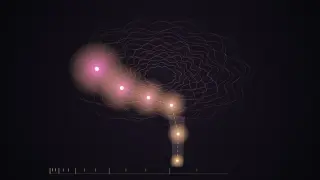
On 1 September 2026, the day Anthropic launched Claude Fable 5.1, Anthropic's Mike Krieger posted a demo in the launch thread. Krieger asked the model to build an interactive model of the human brain that traces what happens when you hear "Could you pass the salt?", using no external assets (Krieger, 2026). The result, called Brainlight, is a public page you can open and use (Brainlight, 2026). Claude's YouTube channel posted a 39-second clip of it the same day (Claude, 2026).
Brainlight's timings, its own page says, come from EEG, MEG and intracranial recordings. We checked them against that research. Most hold up. The places where they don't are the same places where textbooks simplify too.
What the demo is
Brainlight calls itself an interactive atlas of the human brain. The cortex is generated in code on the viewer's device, with no scans or downloaded models. A side panel offers everyday stimuli, including seeing a familiar face, hearing a sentence, a favourite song coming on, touching a hot pan, saying a sentence and reading a word. Each one replays, in slow motion, the order in which brain regions respond (watch from 0:00; 0:09).
Clicking a region opens a card covering what the region does, when it lights up and what happens when it is damaged. The clip shows the fusiform gyrus, home of face recognition (watch from 0:21).
The sentence scenario runs for 900 ms. These are its main steps, as listed in the page's code:
Time | Region | The demo's label |
|---|---|---|
5 ms | Brainstem | Cochlear nuclei, superior olive: timing and location |
15 ms | Thalamus | Medial geniculate relay |
20 ms | Heschl's gyrus (primary auditory cortex) | Frequency and onset tracking |
90 ms | Left superior temporal cortex | Phonemes to word forms (the right side tracks prosody) |
220 ms | Broca's area | Syntax: "could you" means a request |
300 ms | Left middle temporal gyrus | N400: the meaning of "salt" |
450 ms | Dorsolateral prefrontal cortex | Deciding to comply |
550–680 ms | Premotor cortex, motor cortex, cerebellum | Planning and making the reach |
Checking the timings
Brainstem at 5 ms: correct. The auditory brainstem response is a series of waves recorded from the scalp. In a 2023 study of 33 adults hearing loud clicks, wave V, the largest, peaked at about 5.5–5.7 ms (Pelaquim et al., 2023). For speech sounds, the matching response arrives at about 6–10 ms (Skoe & Kraus, 2010).
Auditory cortex at 20 ms: correct. Recordings taken directly from the human auditory cortex during surgery found the first responses to clicks at about 15 ms, with a second peak at about 19 ms (Celesia, 1976). Depth electrodes place a response at about 30 ms in the inner part of Heschl's gyrus, the primary area (Liégeois-Chauvel et al., 1994). Newer intracranial work shows activity starting under 25 ms there, then spreading outwards over the next 100 ms (Nourski et al., 2014).
Thalamus at 15 ms: not checked separately. It sits, correctly, between the brainstem and cortex in the sequence.
Speech sounds near 100 ms: reasonable. The large N1 response from auditory cortex peaks at about 100 ms (Pelaquim et al., 2023), the stage at which sound is turned into speech categories.
Meaning at 300–400 ms: right, with a nuance. The N400 is the brain's best-known signature of meaning. It was first reported for sentences with nonsensical endings (Kutas & Hillyard, 1980). It is a negative wave between about 200 and 600 ms that peaks around 400 ms, and its latency is remarkably stable (Kutas & Federmeier, 2011). The demo starts it at 300 ms and its summary says "around 400", which both fit. The nuance is that meaning does not wait for the N400: lexical, semantic and grammatical signatures can appear together within 100–250 ms (Pulvermüller et al., 2009).
"Could you" as a request at 220 ms: plausible. Philosophers call "Could you pass the salt?" an indirect speech act: literally a question about ability, understood as a request (Searle, 1975). Brain studies suggest this is recognised early:
Spoken dialogue. The type of speech act produced frontal brain responses about 200 ms after an utterance began, before its last word (Gisladottir et al., 2015).
Written words. Requests and naming differed from about 120 ms (Egorova et al., 2013). These were written one-word requests, not spoken indirect ones.
"Deciding to comply" at 450 ms: the region fits, the clock is illustrative. Imaging studies show indirect requests engage motor areas and the network for reading other people's intentions (van Ackeren et al., 2012). Indirect replies engage medial prefrontal cortex, the right temporo-parietal junction and inferior frontal cortex (Bašnáková et al., 2014). MEG shows activity related to meaning spreading to both frontal lobes between about 370 and 500 ms (Kutas & Federmeier, 2011). But we found no study that times a decision to comply. The 450 ms step, and the reach that follows, are a sensible illustration rather than a measured result.
Two simplifications worth knowing
Each clock starts with its own sound. These latencies are measured from the onset of each sound or word, not from the start of the sentence. "Salt" is the last word of a sentence that takes about a second to say. A real listener's brain is processing "could", "you", "pass" and "salt" in overlapping waves, each with its own 5 ms, 20 ms and 400 ms. One 900 ms clock compresses all of that into a single pass.
It is not a relay race. A step-by-step timeline suggests that each region finishes, then hands off to the next. The evidence points to overlap: activity spreads through auditory cortex in parallel, not in strict sequence (Nourski et al., 2014), and early language signatures arrive almost together (Pulvermüller et al., 2009). The demo's long "hold" times, where regions stay lit as others join, partly capture this.
One small mismatch: the video description says the replay is slowed about a hundredfold, but the page's speed menu offers 1/25, 1/9, 1/3 and real time.
Why this is interesting
As a teaching tool, Brainlight gets the first 20 ms exactly right and the meaning stage right within the usual ranges. Its later steps are honest simplifications of things science has not pinned down. That is a good result for a single model-built page, and a reason to check the sources before treating any polished visual as data.
It also has a familiar shape. Our own interactive 3D timeline of language in the brain steps through an illustrative 600 ms timeline on a brain atlas, with sources and limits listed. And the model that built this demo comes from the same family that Anthropic studies with neuroscience-style tools, as our post on Claude's circuits, emotions and workspace explains.
References
Bašnáková, J., Weber, K., Petersson, K. M., van Berkum, J., & Hagoort, P. (2014). Beyond the language given: The neural correlates of inferring speaker meaning. Cerebral Cortex, 24(10), 2572–2578. https://doi.org/10.1093/cercor/bht112
Brainlight: An interactive atlas of the human brain [Interactive web page]. (2026). Claude. Retrieved October 10, 2026, from https://claude.ai/code/artifact/79e71181-9feb-4ec4-ab2a-8c528147e038
Celesia, G. G. (1976). Organization of auditory cortical areas in man. Brain, 99(3), 403–414. https://doi.org/10.1093/brain/99.3.403
Claude. (2026, September 1). Claude codes a sentence traveling through a brain [Video]. YouTube. https://www.youtube.com/watch?v=PK_twqwWqp4
Egorova, N., Shtyrov, Y., & Pulvermüller, F. (2013). Early and parallel processing of pragmatic and semantic information in speech acts: Neurophysiological evidence. Frontiers in Human Neuroscience, 7, Article 86. https://doi.org/10.3389/fnhum.2013.00086
Gisladottir, R. S., Chwilla, D. J., & Levinson, S. C. (2015). Conversation electrified: ERP correlates of speech act recognition in underspecified utterances. PLOS ONE, 10(3), Article e0120068. https://doi.org/10.1371/journal.pone.0120068
Krieger, M. [@mikeyk]. (2026, September 1). Channeling my cogsci background, I asked it to build an interactive model of the human brain [Post]. X. https://x.com/mikeyk/status/2094864472196501940
Kutas, M., & Federmeier, K. D. (2011). Thirty years and counting: Finding meaning in the N400 component of the event-related brain potential (ERP). Annual Review of Psychology, 62, 621–647. https://doi.org/10.1146/annurev.psych.093008.131123
Kutas, M., & Hillyard, S. A. (1980). Reading senseless sentences: Brain potentials reflect semantic incongruity. Science, 207(4427), 203–205. https://doi.org/10.1126/science.7350657
Liégeois-Chauvel, C., Musolino, A., Badier, J. M., Marquis, P., & Chauvel, P. (1994). Evoked potentials recorded from the auditory cortex in man: Evaluation and topography of the middle latency components. Electroencephalography and Clinical Neurophysiology/Evoked Potentials Section, 92(3), 204–214. https://doi.org/10.1016/0168-5597(94)90064-7
Nourski, K. V., Steinschneider, M., McMurray, B., Kovach, C. K., Oya, H., Kawasaki, H., & Howard, M. A. (2014). Functional organization of human auditory cortex: Investigation of response latencies through direct recordings. NeuroImage, 101, 598–609. https://doi.org/10.1016/j.neuroimage.2014.07.004
Pelaquim, A., Sanfins, M. D., & Fornazieri, M. A. (2023). Standardization of latency and amplitude values of short, middle and long latency auditory evoked potentials in adults. International Archives of Otorhinolaryngology, 27(2), e278–e285. https://doi.org/10.1055/s-0043-1768203
Pulvermüller, F., Shtyrov, Y., & Hauk, O. (2009). Understanding in an instant: Neurophysiological evidence for mechanistic language circuits in the brain. Brain and Language, 110(2), 81–94. https://doi.org/10.1016/j.bandl.2008.12.001
Searle, J. R. (1975). Indirect speech acts. In P. Cole & J. L. Morgan (Eds.), Syntax and semantics: Vol. 3. Speech acts (pp. 59–82). Academic Press. https://doi.org/10.1163/9789004368811_004
Skoe, E., & Kraus, N. (2010). Auditory brain stem response to complex sounds: A tutorial. Ear and Hearing, 31(3), 302–324. https://doi.org/10.1097/AUD.0b013e3181cdb272
van Ackeren, M. J., Casasanto, D., Bekkering, H., Hagoort, P., & Rueschemeyer, S.-A. (2012). Pragmatics in action: Indirect requests engage theory of mind areas and the cortical motor network. Journal of Cognitive Neuroscience, 24(11), 2237–2247. https://doi.org/10.1162/jocn_a_00274