
Fruit Fly
Eris Put a Fruit-Fly Connectome to Work on Next-Token Prediction
Eris’s flytokens experiment repurposes the newly released male fruit-fly connectome for next-token prediction, from direct neural input to a vision-and-leg decoder demo.
 Akmal Alif · 10 September 2026 MYT
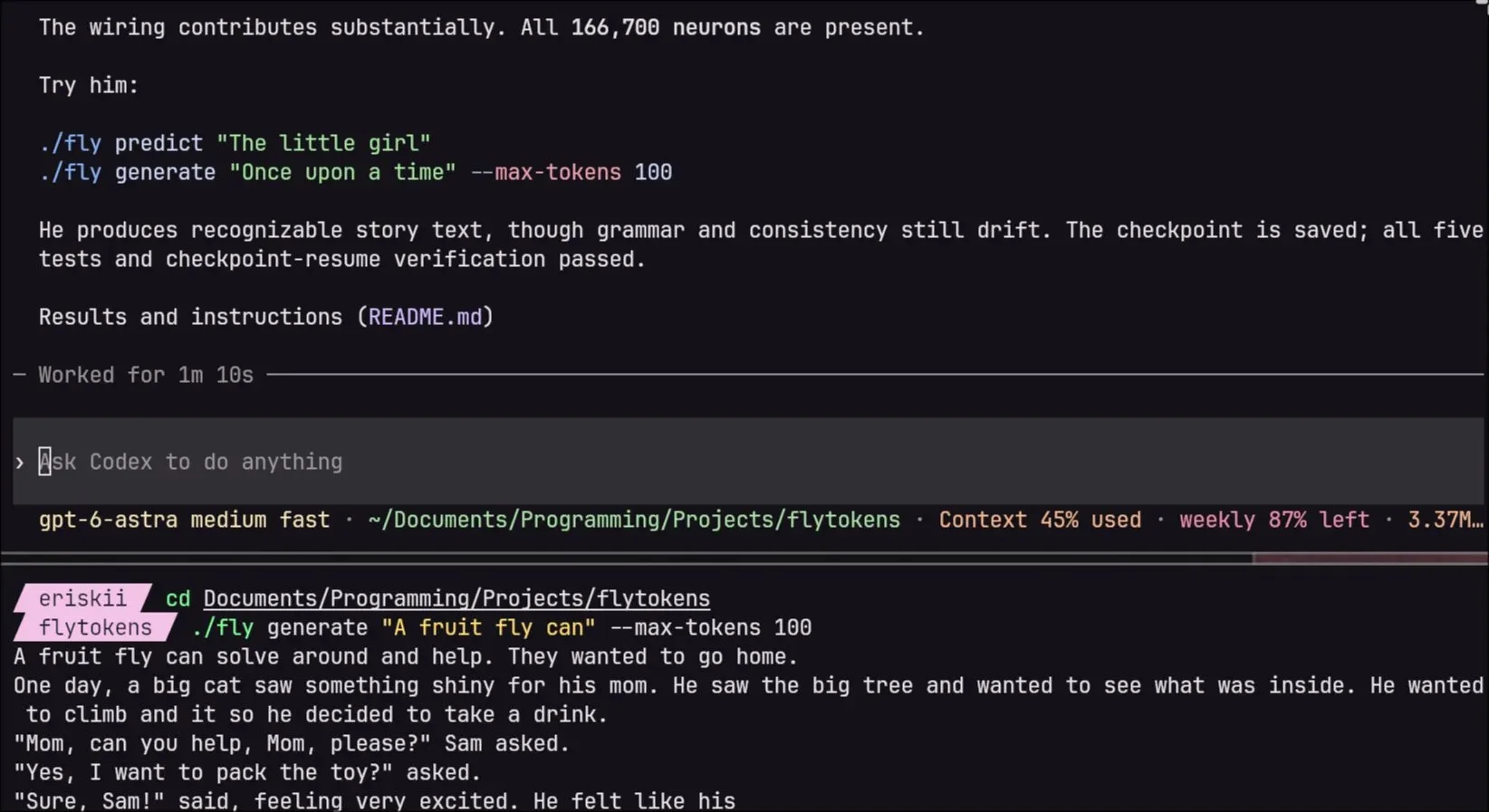
On September 9, 2026, the X user Eris posted a concise, provocative claim: “I have trained that fruit fly to predict the next token.” The attached terminal showed a program called flytokens continuing an English prompt with recognisable, if unstable, story text. A later video placed visual input, a neural display and an articulated fly inside a demonstration labelled “Speak through legs.”
The experiment is interesting precisely because it sits between a real scientific resource and a private prototype. The wiring resource is the newly released male fruit-fly connectome. The language results, training system and evaluation are Eris’s report. EXEPERT has not independently reproduced them.
What Eris showed publicly
In the first requested post, Eris says the fruit-fly model was trained to predict the next token. The supplied terminal capture shows commands for predicting after “The little girl” and generating 100 tokens after “Once upon a time.” A second run begins “A fruit fly can” and produces an English-like continuation with characters, objects and dialogue, while grammar and narrative consistency drift.
The same capture states that all 166,700 neurons are present, that the wiring “contributes substantially,” that five tests passed and that checkpoint resume was verified. Eris has also presented ablation figures around the role of that wiring. These are author-reported results. We did not run the tests, inspect the checkpoint or reproduce the ablations.
The neuron count closely matches the scale of the new MaleCNS release, but matching a row count does not establish that every reconstructed cell participates equally or biologically. Some may be silent, masked or only carried as graph records. What matters for the language claim is the active computation and the counterfactual performance when the biological structure is replaced.
Direct neural input is not the same as seeing words
The first demonstration should be understood as a direct-input language experiment. Tokens must be converted into numerical patterns, delivered to a simulated network, and decoded back into token scores. When that adapter injects a representation directly into neural state, it bypasses the retina, optic pathways and embodied sensory learning that a living fly would use.
That does not make the result meaningless. It makes the division of labour essential. A tokenizer decides the units; an input adapter decides which neurons or state variables receive each unit; the recurrent connectome-based network transforms the signal; and a decoder maps selected activity to probabilities over the next token. Training may also adjust adapters, readouts or internal parameters. Without the source, we cannot say which components were learned, frozen or dominant.
“The connectome predicted a word” is therefore shorthand for a software pipeline in which connectome-derived structure participates. The scientific question is whether that structure adds measurable generalisation beyond what the encoder, decoder and training procedure could achieve on their own.
The vision-and-leg follow-up is a separate experiment
In the 35-second follow-up, the screen changes from a terminal-only model to a multimodal-looking pipeline. The interface shows visual frames, a connectome view, an articulated fly and leg-related signals while text is generated. The presentation suggests that visual input is encoded into the simulated network and activity associated with legs or motor output is used as a decoder.
This should be separated from direct injection. A visual front end introduces its own feature extractor and mapping into the neural simulation. A leg-based decoder introduces another learned or designed mapping on the output side. The intermediate network may influence the transformation, but the video alone cannot reveal how much work is done by the vision encoder, the connectome dynamics, the leg readout or the language decoder.
Nor does the interface mean a biological fly is reading English or speaking through its legs. It is a software experiment that routes information through a connectome-based simulation and assigns semantic meaning to selected outputs.
What remains unavailable for verification
As of September 10, 2026, EXEPERT could not locate a public flytokens repository, checkpoint, training corpus, tokenizer, configuration or controlled baseline. A web search, GitHub search and Hugging Face search did not surface those artifacts. In a reply asking for an upload, Eris answered that it would come “soon,” once the system can read.
That leaves basic questions open: What objective and data were used? How were train, validation and test sets separated? Which parameters changed during training? How large are the input and output adapters? What does “all 166,700 neurons are present” mean computationally? How were the five tests defined? How were the wiring ablations constructed, and were random seeds held constant?
The generated paragraph is evidence that a displayed run produced locally coherent fragments. It is not yet a held-out language-model evaluation. A single sample can be shaped by decoding temperature, prompt selection, memorised training text or an unusually favourable seed.
A connectome simulation is not a captured mind
The MaleCNS dataset is a reconstruction of neuronal wiring in one adult male fruit fly’s central nervous system. A model built from that graph still needs assumptions about cell dynamics, synaptic signs, timing, plasticity and input–output interfaces. It does not contain the living animal’s metabolism, body, sensory stream or complete physiological state.
For the same reason, English-like output does not demonstrate language comprehension, consciousness or the recovery of a fly’s memories. Next-token prediction measures a conditional statistical task. Even excellent scores would show that this engineered system learned that task—not that a fly understands a story, became sentient or had its mind uploaded.
The experiment worth taking seriously
The strongest interpretation is also the most useful: Eris is probing whether biological wiring can serve as an inductive bias for an unfamiliar computational objective. Sparse, recurrent, highly structured graphs differ from standard transformer blocks. If connectome structure helps at equal parameter, data and compute budgets, that would be a result worth studying. If a small decoder does nearly everything, that would be informative too.
This is why the prototype should neither be promoted as digital life nor dismissed because its first prose wanders. Its value depends on controlled comparisons that isolate where performance comes from.
The reproducibility tests that matter
Held-out metrics: report cross-entropy, perplexity or accuracy on a frozen test set, plus sampling settings and confidence intervals across seeds.
Decoder-only baselines: train the same tokenizer, embeddings and readout without the connectome, matching parameter count and compute.
Wiring controls: compare the biological graph with fully random wiring and degree-preserving rewires so node degree cannot masquerade as connectomic structure.
Component ablations: isolate direct input, recurrent dynamics, visual encoding, leg readout and any learned projection, with identical data splits.
Published artifacts: release code, exact data provenance, tokenizer, checkpoints, configs, seeds and scripts that regenerate every table and sample.
Until then, flytokens is a compelling author demo with unresolved evidence, not an established language architecture. For a fully inspectable browser experiment built from the same MaleCNS release, read EXEPERT’s guide to Xenova’s Neural Canvas. Together, the projects show why connectomes are becoming a programmable medium—and why careful boundaries matter as much as impressive motion or text.