
Fruit Fly
Step Inside a Fly: Amy Sterling's Interactive Tour of a Whole Fly Nervous System
Amy Sterling's interactive tour walks through a whole fruit fly nervous system, brain and nerve cord, in the browser. We embed it, explain the BANC connectome behind it, go through its eleven stages and four circuits, and separate what is real data from what is illustration.
 Akmal Alif · 11 October 2026 MYT
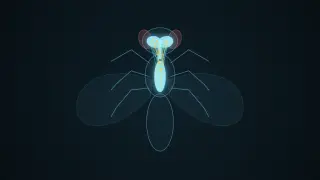
What does it look like to walk through a complete nervous system, one cell at a time? On 5 September 2026 Amy Robinson Sterling (@amyneurons) put a work-in-progress answer online: an interactive tour of the fruit fly's brain and nerve cord that runs in the browser, works on a phone and ends with the stories of real circuits (Sterling, 2026a). Sterling is executive director of EyeWire and crowdsourcing manager of FlyWire, the Princeton-led project that mapped the fly brain, and co-developed FlyWire's Codex data explorer (Princeton Engineering, 2024).
The tour is embedded below. It opens at stage 2, "Inside the fly". Press the button to load it, then use the arrows to move through the stages.
The dataset: the BANC
The tour is built on the BANC, short for Brain And Nerve Cord. It was published in Nature in June 2026 as "Distributed control circuits across a brain-and-cord connectome" by Bates, Phelps, Kim, Yang and more than a hundred colleagues, with Wei-Chung Allen Lee as senior author (Bates et al., 2026).
Earlier whole-brain maps, such as FlyWire's 2024 connectome of the adult fly brain, stopped at the neck (Dorkenwald et al., 2024; Schlegel et al., 2024). The BANC is the first densely reconstructed adult fly connectome that joins the brain to the ventral nerve cord, the fly's equivalent of a spinal cord, in a single animal. That matters because behaviour does not live in the brain alone. Walking, grooming and flight depend on loops that run between the two.
The tour puts the BANC at 158,262 neurons and about 199 million synapses, all from one female fly (Sterling, n.d.). For comparison, its opening stage notes that FlyWire's earlier whole-brain dataset contains 139,255 neurons.
The paper's main finding gives the tour its theme. Instead of one command centre, the authors describe local feedback loops in the brain and the nerve cord, linked by ascending and descending neurons organised around behaviours. They call this a distributed control architecture (Bates et al., 2026).
The tour, stage by stage
The tour has eleven stages. A number in the address picks the stage, which is how the embed above opens at stage 2 (Sterling, n.d.).
Codex. An introduction to FlyWire Codex, the window onto five open connectome datasets, with a hologram switch.
Inside the fly. The hologram turns on to show the nervous system inside the fly's head and thorax, about a millimetre from end to end.
The BANC. Brain, neck connective and nerve cord, labelled: 158,262 neurons from one animal.
The neurons. 154 of those neurons, colour-coded: descending neurons that carry commands down from the brain, ascending neurons that carry feedback up, and other cells.
Walking. Six cells: a descending pair that carries the command to walk, and ascending neurons that report back from the legs.
Steering. Four cells, one pair on each side. Steering is a comparison between the two sides.
Six legs, one command. A tripod gait replayed on a model fly body.
Grooming. A 28-cell circuit, driven by a descending neuron that triggers head grooming.
Be the fly. A small game: steer the fly towards a peach.
Every cell we met. All 154 cells, pulsing together.
Your turn. A set of missions to explore further in Codex.
Four circuits, explained
Walking. The brain does not micromanage each leg. A single pair of descending neurons, DNg100, carries the command to walk down to the nerve cord. Circuits there coordinate the legs, and ascending neurons send feedback about the legs' state back up. This is the distributed-control idea in miniature: the brain decides, the cord executes.
Steering. Two pairs of descending neurons, DNa01 and DNa02, one on each side. The tour describes steering as a comparison: what matters is the difference in activity between the left and right pairs. It is careful not to claim which way a given imbalance turns the fly.
Legs in motion. The walking animation uses NeuroMechFly, a biomechanical fly model from EPFL, playing back recorded steps in a tripod gait at about a tenth of real speed. Three legs move together while the other three hold the body up. The tour notes that the circuit lighting up on screen does not drive these legs; the animation is a replay.
Grooming. A 28-cell circuit centred on DNg12, a descending neuron that drives the fly to groom its head. Grooming is a classic model for how a nervous system sequences actions, and the connectome lets you trace the whole chain.
What is real and what is illustrative
The tour is honest about its parts, and that is part of its value (Sterling, n.d.):
The neurons and their connections are real. They come from the public BANC meshes, version 888.
The body is a model. The fly is NeuroMechFly, and the nervous system was positioned inside it by hand.
The pulses are illustrative. The flashes of activity show which cells belong to a circuit. They are not recordings of a real fly.
Keeping those lines clear is what turns a beautiful animation into a trustworthy teaching tool.
Beyond the tour
The last stage hands you the controls. The missions include following light from the eye through looming detectors to the giant fiber that triggers an escape jump, finding the fly's compass and dopamine cells, comparing the PFL3 steering pathway in two different flies, and looking at a descending neuron, DNp03, whose role is still unclear. There is even an invitation to suggest a pathway for the next version.
The tour also shows how far fly connectomics has come in two years. When Sterling announced it, the male fly's complete central nervous system had just appeared in Cell (Sterling, 2026b). Our post on the Fly Brain Minecraft mod shows that male connectome driving a fly inside a game. Connectomes are becoming things people can play with, not just read about.
References
Bates, A. S., Phelps, J. S., Kim, M., Yang, H. H., et al. (2026). Distributed control circuits across a brain-and-cord connectome. Nature, 656(8129), 957–970. https://doi.org/10.1038/s41586-026-10735-w
Dorkenwald, S., et al. (2024). Neuronal wiring diagram of an adult brain. Nature, 634, 124–138. https://doi.org/10.1038/s41586-024-07558-y
Princeton Engineering. (2024, October 2). Mapping an entire (fly) brain: A step toward understanding diseases of the human brain. https://engineering.princeton.edu/news/2024/10/02/mapping-entire-fly-brain-step-toward-understanding-diseases-human-brain
Schlegel, P., et al. (2024). Whole-brain annotation and multi-connectome cell typing of Drosophila. Nature, 634, 139–152. https://doi.org/10.1038/s41586-024-07686-5
Sterling, A. R. [@amyneurons]. (2026a, September 5). I put my work-in-progress interactive fly connectome explorer online [Post]. X. https://x.com/amyneurons/status/2096208900844409098
Sterling, A. R. [@amyneurons]. (2026b, September 4). Step inside a fly and follow sight, walking, steering and grooming circuits [Post]. X. https://x.com/amyneurons/status/2095898399077740565
Sterling, A. R. (n.d.). Codex: A whole nervous system, one cell at a time [Interactive web page]. Retrieved October 11, 2026, from https://whatisabrain.com/fly/