
EXEPERT Updates
Why an Underground Route Is (Barely) Shorter: A KLCC Walking Thought Experiment
A walk from KLCC LRT becomes a globe-scale geometry experiment—and shows why real entrances, turns, and level changes matter far more than Earth’s curvature.
 Akmal Alif · 14 September 2026 MYT
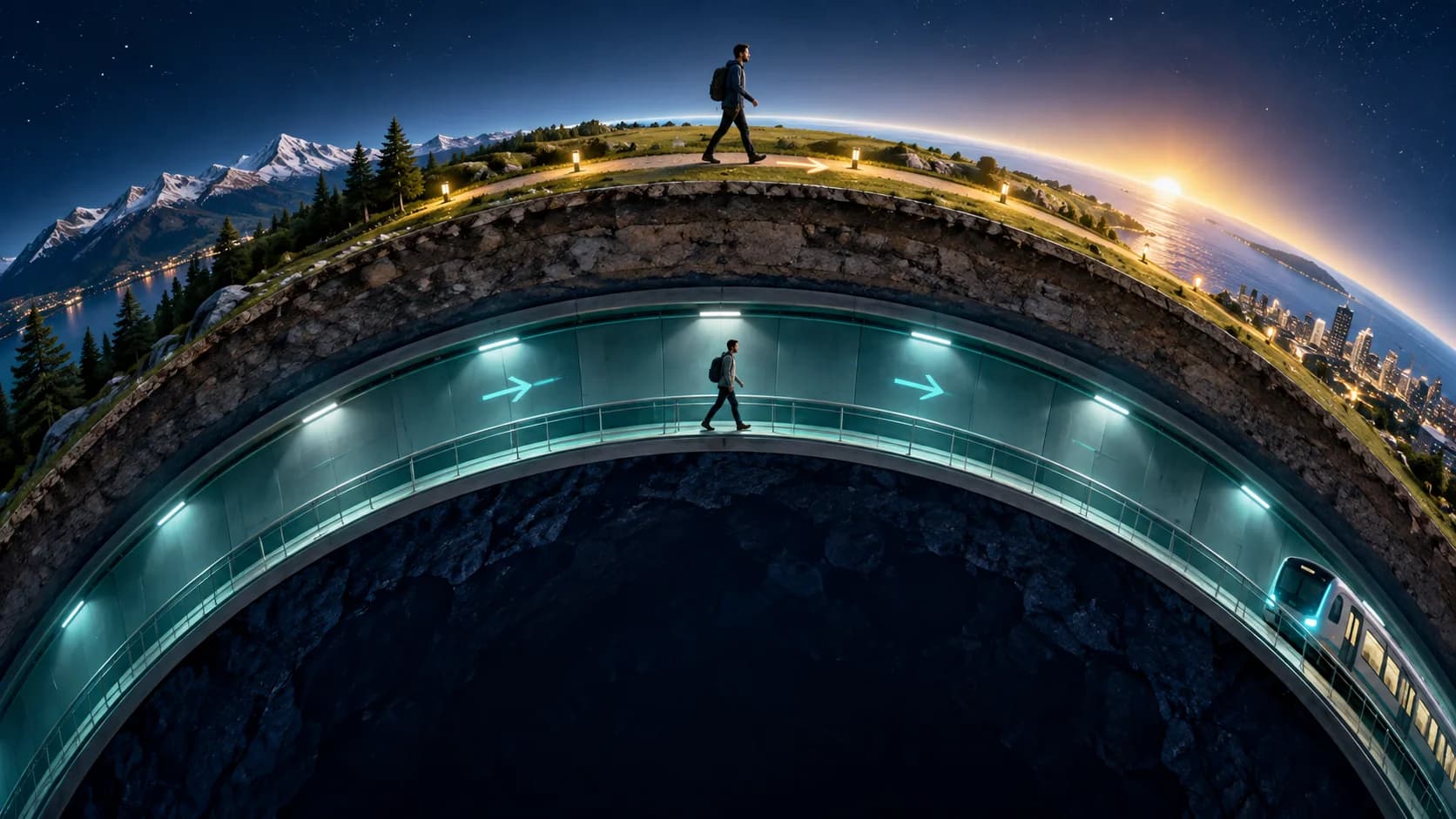
One morning on my way to work, I left KLCC LRT and followed the indoor pedestrian connection through Suria KLCC toward the Kuala Lumpur Convention Centre. Somewhere inside that long, enclosed walk, I pictured Kuala Lumpur not as a street plan but as a tiny curve on a globe. If another person walked above me in the same direction while I stayed underground, would my route be shorter because I was slightly closer to the centre of Earth?
That sketch was onto something—but only as a clean geometry model. It does not mean a person underground walks faster, and for a human trip across KLCC the mathematical saving is so small that one doorway, turn, ramp, or crowd overwhelms it.
The interesting part is the gap between a true statement and a useful one.
The concentric-circle idea
Imagine a cross-section of Earth as a circle. One walker follows the surface at radius R. A second walker follows a perfectly concentric tunnel at depth d, so the tunnel radius is R − d. Both begin and finish at the same angular positions, separated by an angle θ measured in radians.
The surface arc is:
s_surface = Rθ
The tunnel arc is:
s_tunnel = (R − d)θ
Subtracting the two gives:
Δs = s_surface − s_tunnel = dθ
That last expression captures the whole picture. The deeper path is shorter because the same angle is swept at a smaller radius. The two arcs are like lanes on a circular track: the inner lane covers less ground through the same turn.
This model needs an important condition. The start and finish must be aligned radially, and both paths must be concentric arcs spanning the same angle. A real pedestrian tunnel normally does not satisfy those conditions. It bends around foundations, connects entrances, changes level, and follows property boundaries. The drawing is therefore a thought experiment, not a survey of the KLCC precinct.
Same walking speed, different distance
My original wording was “shorter distance equals faster to reach.” A more accurate version is: shorter distance equals less travel time when speed is the same.
For either walker,
t = s / v
where t is travel time, s is path length, and v is walking speed. If both people maintain 1.4 metres per second, neither person is intrinsically faster. In the idealized diagram, the underground person simply has a marginally shorter s. Their speedometers would agree; their arrival times would differ only because one route contains less arc.
How small is “barely”?
Use a deliberately generous example: suppose the surface arc is exactly 1 kilometre, the tunnel is 20 metres below it, and both routes are perfect concentric arcs. Taking Earth’s radius as approximately 6.371 million metres—consistent with the dimensions summarized by NASA (n.d.)—the angular span is:
θ = 1,000 / 6,371,000 ≈ 0.00015696 radians
The distance saving is then:
Δs = 20 × 0.00015696 ≈ 0.00314 metres
That is about 3.1 millimetres over a full kilometre. At 1.4 metres per second, the time saving is:
Δt = 0.00314 / 1.4 ≈ 0.0022 seconds
So the idealized underground walker arrives roughly 2.2 milliseconds earlier. The example intentionally exaggerates the depth and gives the geometry every advantage; the result is still smaller than the thickness of a few coins and far below human perception.
The relative reduction is d/R—roughly three millionths of one percent here. Earth is so large that paths separated by a few floors have practically the same radius.
Why a real tunnel may be longer—or much faster
In a city, route design dominates planetary curvature. The underground route could be shorter if it cuts beneath a blocked parcel or replaces a street detour with a direct connection. It could be longer if it loops around building foundations or sends walkers to a distant entrance. It could take less time because it avoids crossings, rain, heat, or dense pavement traffic. It could take more time because of stairs, escalators, security queues, lift waits, or confusing signs.
Vertical travel also counts. Descending and climbing add distance unless the endpoints are already below ground, while accessible routes may appropriately trade distance for a gentler gradient.
The practical comparison is the length and expected time of two complete door-to-door routes: every corridor, level change, entrance, crossing, and wait. A measured trace or wayfinding plan can answer that question. A globe cannot.
What about gravity and clocks?
Being deeper in Earth’s gravitational field also changes the rate at which a clock ticks. General relativity predicts that a clock at lower gravitational potential runs slightly slower than one at a higher elevation, and precision optical clocks can measure such differences over remarkably small height changes (National Institute of Standards and Technology, 2022).
Gravitational time dilation is real but irrelevant to who reaches the exit first. A 20-metre height difference produces a fractional clock-rate difference near 2 × 10⁻¹⁵, accumulating only picoseconds during a walk. The 2.2 milliseconds above comes from assumed path length; relativity neither changes leg speed nor explains it.
MRT maps and tunnels for guidance
The thought experiment began during a real KLCC walk, so it is worth separating the places and the maps.
The Kuala Lumpur Convention Centre documents an underground Concourse-level pedestrian tunnel connecting the Centre with Suria KLCC, the PETRONAS Twin Towers precinct, KLCC LRT, and the KL94 bus stop. Its directions send LRT passengers through Suria and the tunnel; the page lists daily hours of 6:00 a.m. to 11:00 p.m. (Kuala Lumpur Convention Centre, n.d.).
That connection is not the same thing as Persiaran KLCC MRT station. For Putrajaya Line passengers, the Convention Centre describes a surface walk through KLCC Park from Persiaran KLCC, or a walk along Jalan Kia Peng from Conlay. MRT Corp lists Persiaran KLCC and Conlay as separate Putrajaya Line stations and provides station and rail-network information for trip planning (Mass Rapid Transit Corporation, n.d.-a, n.d.-b).
I did not find an official, network-wide map of every underground pedestrian corridor, entrance, concourse, and exit during this research. The familiar transit maps are rail-network diagrams: they are excellent for choosing lines and interchanges, but they do not attempt to trace every passage a person can walk after leaving a platform.
Readers planning a KLCC trip should combine these sources:
Kuala Lumpur Convention Centre pedestrian directions for the documented KLCC LRT–Suria–Convention Centre connection and local walking approaches.
MyRapid integrated transit map for Rapid KL lines and interchanges (Rapid Rail Sdn Bhd, n.d.).
MRT Corp’s travel map for the MRT rail network and station sequence (Mass Rapid Transit Corporation, n.d.-a).
Persiaran KLCC MRT station information for that station’s entrances and facilities (Mass Rapid Transit Corporation, n.d.-b).
On the ground, follow current station and building signs, especially when construction or access hours change. A schematic rail map tells you which station to use; venue directions and local wayfinding tell you how to complete the pedestrian leg.
A tiny truth inside a useful observation
The visualization is scientifically accurate under a narrow assumption: two concentric paths cover the same angle, so the inner one is shorter. It becomes inaccurate if it says the underground person moves faster, if it treats an actual MRT passage as a concentric arc, or if it implies that Earth’s curvature meaningfully determines a KLCC commute.
I still like the sketch because it turned an ordinary walk into a good question. Its answer is not simply “yes” or “no.” Yes, the idealized inner arc is shorter. No, the person is not walking faster. And in the real city, the geometry of entrances, corridors, and obstacles matters millions of times more.
References
Kuala Lumpur Convention Centre. (n.d.). Getting to the Centre and car parking. Retrieved September 13, 2026, from KL Convention Centre source
Mass Rapid Transit Corporation Sdn Bhd. (n.d.-a). Travel with MRT. Retrieved September 13, 2026, from MRT Corp source
Mass Rapid Transit Corporation Sdn Bhd. (n.d.-b). Persiaran KLCC MRT station. Retrieved September 13, 2026, from MRT Corp source
National Aeronautics and Space Administration. (n.d.). Earth facts. Retrieved September 13, 2026, from NASA source
National Institute of Standards and Technology. (2022, February 16). JILA atomic clocks measure Einstein’s general relativity at millimeter scale. NIST source
Rapid Rail Sdn Bhd. (n.d.). Rapid KL integrated transit map. MyRapid. Retrieved September 13, 2026, from MyRapid source