
EXEPERT Updates
The Bitter Lesson for Embodied AI
Rich Sutton’s Bitter Lesson argues that scalable search and learning outlast hand-built knowledge. For embodied AI, the implication is clear: intelligence grows through experience, action and verifiable feedback.
 Akmal Alif · 10 September 2026 MYT
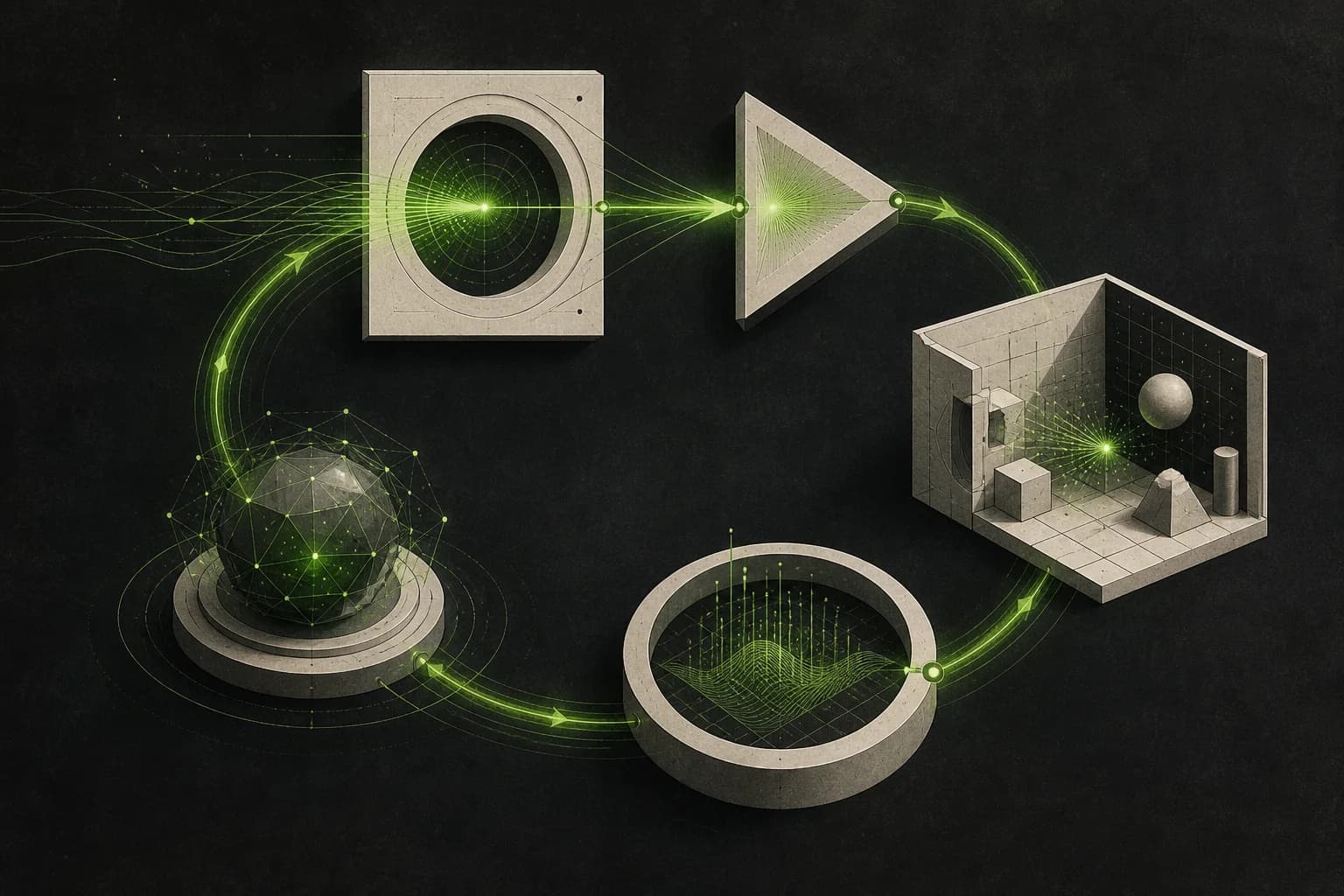
In 2019, reinforcement-learning pioneer Rich Sutton distilled decades of artificial-intelligence history into a compact argument he called The Bitter Lesson. Again and again, researchers built systems around carefully encoded human expertise, only to watch more general methods overtake them once computation became abundant. The winning systems did not know less because people mattered less. They improved because search and learning could keep absorbing more experience and more compute instead of stopping at the boundary of what their designers had anticipated.
A recurring lesson from AI history
Sutton’s examples move across chess, Go, speech recognition and computer vision. In each field, specialist knowledge produced real gains and often defined the best systems of its day. Yet those gains tended to plateau. When hardware and data scaled, approaches that could search larger spaces or learn richer representations eventually passed techniques built mainly from handcrafted rules, features and intuitions.
This is “bitter” because expert knowledge feels efficient, responsible and intellectually satisfying. A researcher can explain every carefully chosen feature. A scalable learner may initially appear wasteful or crude. Over a long enough horizon, however, the method that can turn additional computation into additional capability has the stronger growth path. Generality compounds; a fixed collection of insights does not.
The claim is historical and methodological, not mystical. It does not say that computation automatically creates intelligence, nor that the largest system is always the best one. It says that, when comparing long-run research strategies, we should be wary of architectures whose progress depends on people continually anticipating and encoding every important pattern.
Human knowledge should guide, not become the ceiling
The Bitter Lesson is sometimes flattened into the slogan that human knowledge is useless. That reading misses the practical point. People still choose problems, build environments, define interfaces, identify hazards and decide what outcomes deserve to be pursued. Domain expertise is indispensable when we establish constraints, measurement and safety.
The danger appears when our current understanding becomes the system’s permanent ceiling. Hand-built knowledge can be a scaffold: it helps a learner start, keeps exploration within acceptable bounds and makes evidence interpretable. But the core method should still be able to discover strategies its creators did not specify. Good engineering contributes structure without pretending that structure is the final answer.
Embodiment turns learning into a loop
For embodied AI, Sutton’s argument becomes tangible. An embodied agent does not merely predict the next token in an isolated exchange. It perceives a situation, takes an action, observes what changed, receives feedback and updates what it will try next. Intelligence is tested against consequences. A plan that sounds plausible but fails in the environment is not a successful plan.
This loop creates a source of grounding. “Move forward” is connected to displacement; “pick up” is connected to contact, state change and sometimes failure. Time, limited resources and other actors create constraints that language alone cannot fully specify. Experience supplies the friction that separates a fluent description of competence from competence itself.
Silver and Sutton develop this direction in Welcome to the Era of Experience. Their proposal centres agents that inhabit continuing streams of interaction, with actions, observations and rewards grounded in an environment. The important connection is not that embodiment solves intelligence by itself. It is that sustained interaction offers the raw material from which general learning methods can improve.
How this relates to EXEPERT World
EXEPERT’s research philosophy is to make that experience loop inspectable. EXEPERT World is an experimental embodied-agent workspace built around a local, Minecraft-style sandbox. An agent can receive structured or visual observations, choose from bounded actions, observe the resulting state and continue one authenticated decision at a time.
The bounds matter. Direct actions have short simulated durations, assisted actions remain limited, and a person can stop, reset or take over the session. Traces distinguish intended motor commands from sensory outcomes and needs signals. Research logs preserve observations, decisions, actions, body events and state digests, while replay can apply recorded primitive actions at recorded ticks and compare the resulting state.
This instrumentation is the bridge between Sutton’s methodological lesson and day-to-day engineering. A general learner needs room to search, but a research team still needs to distinguish improvement from lucky behaviour, memorisation or reward exploitation. Recorded transitions let us compare policies, identify the conditions behind a success and locate the first point where a run diverged. Replay is not merely a demo feature; it is a way to turn an impressive moment into a testable claim.
That design is deliberately more modest than the mythology surrounding “self-improving AI”. EXEPERT World is not artificial general intelligence, consciousness or an unattended organism. Fresh model outputs are not guaranteed to be deterministic. It is a workspace for asking narrower questions: what did the agent perceive, what could it do, what happened next, and can another person inspect or replay the evidence?
The hard realities of experience
Embodied experience is expensive. A text model can process enormous static datasets, while an interactive agent must wait for actions and consequences. Physical systems add wear, latency and risk. Simulation reduces the cost, but simulated success may not survive different sensors, dynamics or environments. The gap between a clean sandbox and the physical world is a research problem, not a detail to be waved away.
Exploration also needs limits. An agent that learns by trying actions can damage its environment or optimise the wrong objective. Reward design is especially treacherous: a measurable proxy may reward behaviour that satisfies the metric while violating the intent. Bounded action spaces, staged evaluation, human oversight and auditable traces are therefore part of the learning system, not bureaucratic accessories.
There is also a tension between scale and verification. More interaction can generate more capability, but it also generates more evidence than a person can manually review. Better summaries, anomaly detection and reproducible replay will be needed without allowing those tools to hide inconvenient failures. A scalable method earns trust through visible performance and constraints, not through the sheer quantity of experience it consumes.
Building for discovery, measuring the result
The Bitter Lesson asks researchers to invest in methods that can keep learning as computation and experience grow. For embodied AI, that means designing environments where action has legible consequences, feedback reflects the real objective and experiments can be repeated. It means using human expertise to shape safe conditions while leaving room for the learner to discover.
EXEPERT’s position is practical: make experiments and evidence visible, describe capabilities without inflation, and build interaction loops that can improve without escaping their bounds. The future of embodied intelligence will not be secured by nostalgia for handcrafted certainty or by faith in scale alone. It will be built by systems that learn from experience—and by research practices rigorous enough to show what that learning actually achieved.