
Neuromorphic
Clear Is Not Enough: Larry McEnerney on Creating Value with Words
Writing that is clear and worthless is still worthless. Larry McEnerney, who ran UChicago's writing program for thirty years, argues that writing moves specific readers, starts from a problem they feel, and lives in their minds, not in rules.
 Akmal Alif · 8 October 2026 MYT
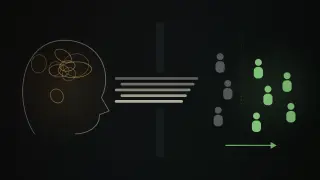
Most advice about writing is about the text: be clear, be organised, use short sentences, avoid the passive voice. Larry McEnerney, who directed the University of Chicago's writing program for thirty years, argues that this advice aims at the wrong target. What matters happens in the reader's mind, and the patterns of language that help a writer think are not the patterns a reader uses to read.
This post follows the ten-minute highlights of McEnerney's April 2023 talk at the NIM, the Nuremberg Institute for Market Decisions, published in January 2024 (NIM – Nürnberg Institut für Marktentscheidungen, 2024). The ideas will be familiar to anyone who has seen The Craft of Writing Effectively, the 2014 lecture that made McEnerney widely known online (McEnerney, 2014). The highlights are a compact version, embedded below, and the timestamps jump to the matching moment.
Clear and worthless is still worthless
The talk opens with an argument with the dean of a prestigious research university, who wanted everyone on campus to write clearly and in an organised way (watch from 0:10). McEnerney told the dean that this was not really what the university wanted, and asked a pointed question. Would a faculty member who writes clear, organised prose but gets no grants, no publications and no citations get tenure? Of course not (watch from 0:52).
Clarity, organisation and even persuasion are not the measure. Value is. Writing that is clear and worthless is worthless; organised and worthless is worthless; persuasive and worthless is still worthless (watch from 1:34).
Thinking patterns and reading patterns
The most interesting claim is about how minds use language. Experts, McEnerney says, use language in particular patterns that help them think. Their readers, even expert readers, use language in a different pattern when they read. The two interfere: the writer's patterns serve the writer and get in the way of the reader (watch from 2:14).
That gives writing three problems (watch from 2:55):
It is very hard.
You have to use writing to help yourself think, and then change it for readers, which is emotionally and intellectually difficult.
You were trained to think about writing through rules.
On the third, McEnerney does not hedge. Rules such as “avoid passive verbs” or “short sentences are clearer” are, in McEnerney's view, demonstrably false. Worse, while you think about rules you are not thinking about readers. Value is created by readers, specific readers, not by rules (watch from 3:36).
Writing moves readers
School teaches a transmission model: there is an idea in the writer's head, and the text's job is to carry it into the reader's head (watch from 4:18). McEnerney says that is no longer the function of professional writing. The function is to take a particular group of readers from one place to another. The text moves them (watch from 4:40).
McEnerney pictures a field as a conversation moving through time. New ideas come in, old ideas drop out, and what counts as a contribution depends on that conversation (watch from 5:22). Writers are trained to stress continuity, to show that their work fits what came before. What actually drives the conversation forward, McEnerney argues, is tension (watch from 6:04).
Start with the problem
So a text should not run from background to thesis, or from general to specific. It should run from problem to solution, and the first thing readers must perceive is that a problem exists (watch from 6:45).
A problem, in McEnerney's sense, has two parts:
Instability. The reader must see that the current situation is unstable: a tension, an inconsistency, a contradiction (watch from 7:07).
Cost or benefit. That instability must either impose a cost on the reader, or resolving it must bring the reader a benefit (watch from 7:28).
Both parts are defined by the reader. A situation is only unstable, and only costly, for someone in particular.
Two announcements, two kinds of value
The closing example is the Nobel Prize. Each prize comes with at least two explanations: a short public announcement and a long technical document (watch from 7:48). Most people assume the difference is expertise: one is for people who do not understand the science, the other for people who do.
McEnerney says that is not why there are two. The two communities value different things. One values pragmatic problems, such as what this changes for people, and the other values conceptual problems, such as what this changes in what we understand. The difference is not how much the readers know but what they value (watch from 8:48).
Why this belongs in Neuromorphic
McEnerney is talking about academic and professional writing, but the claim underneath it is cognitive. Writing is an attempt to change another mind, and the same words do different work in the head that produces them and the head that reads them.
That matters more as language models make fluent text almost free. Clear, organised, grammatical prose is now the easy part. A model can make a draft cleaner, but it cannot tell you which readers you are writing for, what they find unstable, or what that instability costs them. Those questions are where the value McEnerney talks about comes from, and they stay with the writer.
References
McEnerney, L. (2014, June 26). LEADERSHIP LAB: The craft of writing effectively [Video]. UChicago Social Sciences, YouTube. https://www.youtube.com/watch?v=vtIzMaLkCaM
NIM – Nürnberg Institut für Marktentscheidungen. (2024, January 25). NIM Distinguished Speakers – Larry McEnerney: The problem of creating value with words (highlights) [Video]. YouTube. https://www.youtube.com/watch?v=3_lTELjWqdY