
Torrent
How Torrent Streaming Works: Swarms, Buffers, Debrid Caches, and CDNs
A protocol-level guide to torrent pieces and playback buffers, how debrid changes the final hop, and why Spotify’s history and Netflix’s CDN are distinct examples.
 Akmal Alif · 14 September 2026 MYT
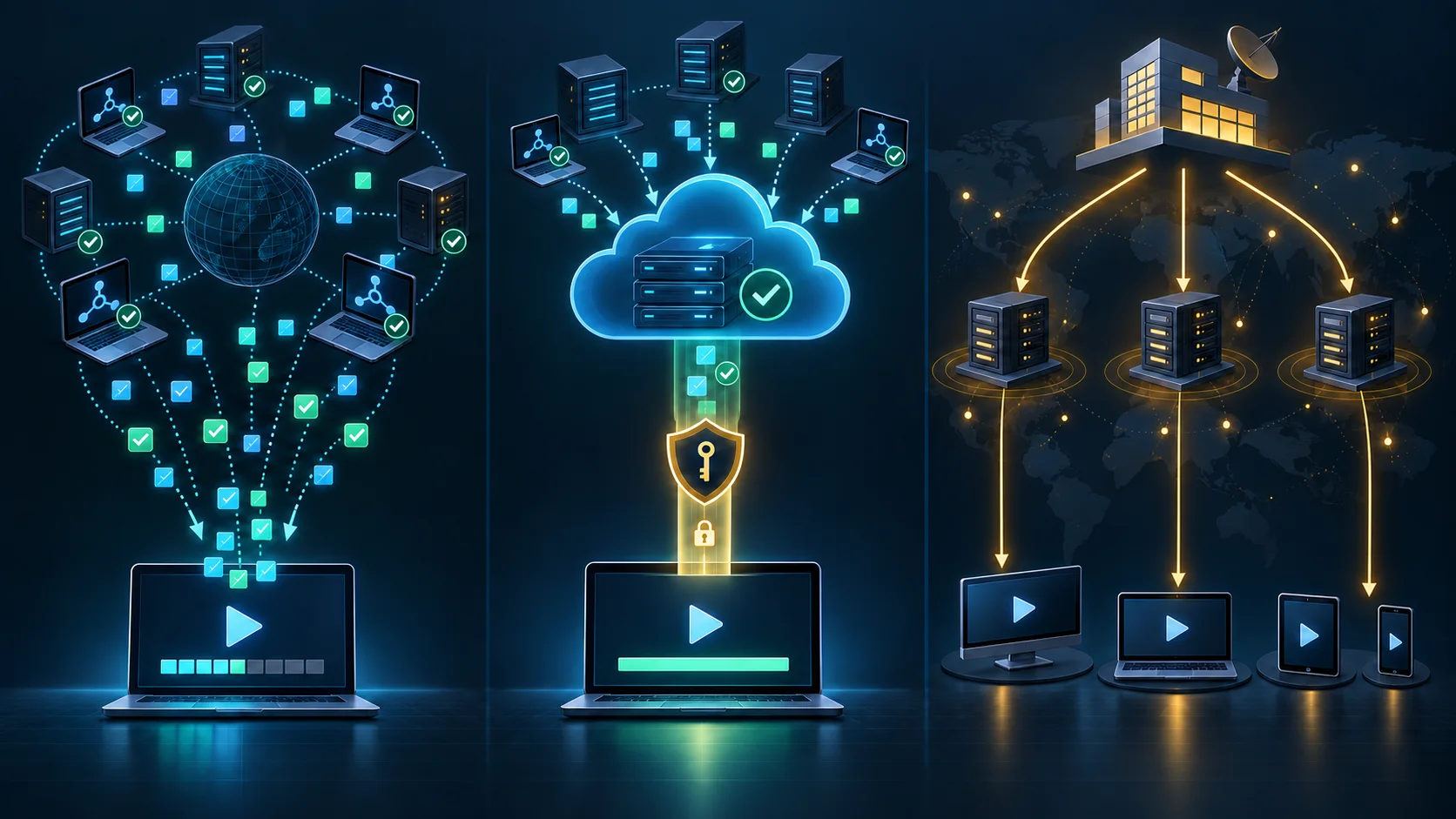
“Torrent streaming” sounds like one technology, but it often describes several very different delivery paths. A media player might fetch pieces directly from a peer-to-peer swarm. It might send a torrent identifier to a debrid provider and receive an ordinary HTTPS stream. Or it might play from a conventional content delivery network, where managed edge servers hold copies near viewers.
All three can begin playback before an entire file reaches the device. That shared result—press play, wait briefly, watch—does not make their network architectures equivalent.
BitTorrent is a general file-distribution protocol with legitimate uses, including open-source software and public datasets. It does not grant permission to share a work; users remain responsible for the source, licence, and applicable law.
From a torrent file to an identity
In the original BitTorrent design, a small .torrent metainfo file describes the transfer. It contains an info dictionary with the file names or layout, piece length, and a sequence of cryptographic piece hashes. It also commonly names one or more trackers. The SHA-1 digest of that exact encoded info dictionary is the info hash, which identifies the torrent swarm in the BitTorrent v1 protocol (Cohen, 2008).
A magnet link is a compact pointer rather than the payload. A typical BitTorrent magnet includes a btih topic containing an info hash. It can also include tracker addresses or a display name. Because a magnet may begin with only the identifier, a client can retrieve the missing metadata from peers using the metadata-exchange extension described in BEP 9 (Norberg, 2008). Once the client has verified that metadata against the requested info hash, it knows the file layout and piece hashes.
In short, metainfo describes how bytes are divided and verified; the info hash identifies that description; and a magnet carries the identifier plus optional starting hints. None necessarily contains the media bytes.
Pieces, blocks, and verification
BitTorrent divides a file or multi-file payload into fixed-size pieces, except for the final piece, which may be shorter. Transfers are requested in smaller blocks, then assembled into pieces. After a complete piece arrives, the client hashes it and compares the result with the trusted hash in the metainfo. A mismatch means the bytes are corrupt or do not belong to that torrent, so the piece is discarded and requested again (Cohen, 2008).
That check protects integrity, not safety or legitimacy. A verified file can still be malware, misleading, or unauthorized. The hash proves only that peers delivered the described bytes.
Every participant exchanging pieces is a peer. A peer with the complete verified payload that keeps uploading is a seeder. Downloaders can upload pieces they already have, so new demand can also add capacity.
How peers find one another
A tracker is a coordination service. A client announces that it participates in a torrent and receives contact details for other peers. The tracker generally does not relay the file; peers exchange pieces directly.
The distributed hash table, or DHT, offers decentralized discovery. BEP 5 defines a Kademlia-style network in which clients also act as DHT nodes and query for peers associated with an info hash (Loewenstern & Norberg, 2008).
Discovery is separate from delivery. Trackers or DHT nodes suggest peers; the peer protocol negotiates availability and block requests. An info hash cannot produce playback when no reachable peer has the required pieces.
Scheduling pieces for playback
A conventional download can prioritize globally rare pieces. “Rarest first” helps keep more of the payload available across the swarm and reduces the risk that an uncommon piece disappears. Streaming adds a deadline: the player needs the next seconds of video soon, not a statistically ideal piece near the end.
A streaming-aware client fetches opening metadata and a playable run of pieces, maintains a contiguous window ahead of playback, and balances urgent requests with swarm health.
The playback buffer is that ready-ahead window. Playback continues while verified bytes arrive faster than they are consumed; it stalls when the buffer empties.
Buffering does not remove verification. A client should expose completed, hash-checked data to the media pipeline, which may also need container metadata before decoding or seeking.
Direct P2P makes the viewer a network participant. Peers normally see the public IP address and port, while network providers can observe traffic relationships and volumes. A VPN shifts this exposure and adds another trusted provider; it does not legalize a transfer.
What a debrid cache changes
A debrid provider places a remote service between the user and the swarm. The user or an application gives the provider a magnet link or info hash. If the provider already has the requested payload in its cache, it can make a direct stream available quickly. If not, the provider may join the swarm, download and verify the content on its own infrastructure, and then expose the completed or progressively available file to the customer.
The final hop is typically:
swarm → debrid infrastructure and cache → HTTPS → viewer
This is not a direct swarm connection from the viewer. Peers see the provider’s infrastructure, but the provider can associate requests with an account or API credential. An addon receiving that credential also enters the trust boundary. “Not visible to peers” is not anonymous.
A cache hit avoids a new swarm fetch. A miss still depends on seeders, provider capacity, file selection, and provider rules. Once ready, HTTP range requests can fetch the regions needed for playback and seeking.
Treat API keys and generated manifest URLs like passwords. They can leak through screenshots, history, logs, analytics, or support messages. Prefer device authorization, limit scope, and rotate exposed credentials.
How a CDN differs
A content delivery network is centrally operated delivery infrastructure. The publisher or streaming service prepares authorized media objects and places them at origin servers. Cache or edge servers hold popular objects closer to audiences. A viewer requests segments over HTTP(S), and routing directs the request to an appropriate edge.
This is one-to-many service delivery, not viewers exchanging pieces:
publisher origin → managed edge cache → HTTPS → viewer
Netflix’s Open Connect is a clear example. Netflix places Open Connect Appliances inside or near internet service-provider networks and prepositions popular catalogue files so much of the traffic can be served locally. Netflix describes the system as a purpose-built CDN that works with participating networks through embedded appliances or settlement-free interconnection (Netflix, n.d., 2021). The appliances are managed distribution caches; Netflix viewers are not BitTorrent peers uploading movie pieces to one another.
Both CDNs and debrid caches may send HTTPS byte ranges. A CDN operates within a publisher’s distribution architecture; a debrid service reacts to user identifiers and may first acquire a file from a third-party swarm.
Spotify: a historical hybrid, not “BitTorrent”
Spotify is often invoked in conversations about torrents, but precision matters. Researchers describing Spotify’s 2010 desktop system reported a proprietary on-demand architecture combining Spotify servers, local caches, and peer-to-peer transfers between authorized clients. Tracks were divided into pieces, and the client selected among server and peer sources to meet a low-latency playback target (Kreitz & Niemelä, 2010).
Spotify Engineering later described this early desktop architecture as a custom “fat client” that hybridized client-server and P2P technology. The historical account emphasizes that the team built its own protocols and infrastructure (Spotify Engineering, 2021). It does not say that Spotify used the BitTorrent protocol, and it is not evidence that Spotify’s current service still delivers music through listener-to-listener P2P.
The comparison is conceptual: both can use end-user upload capacity and caches. Protocol identity, authorization, catalogue control, and present-day operation remain separate facts. Calling historical Spotify “a torrent service” collapses them.
Netflix: the useful counterexample
Netflix illustrates the other choice. Open Connect predicts demand, fills managed appliances with encoded files, and serves them near members; Netflix and ISP partners coordinate capacity and placement (Netflix, 2021).
BitTorrent gains elastic distribution from peers; a debrid service reuses requested cache objects; a CDN gains managed control at scale. Each reduces distant-origin load through a different ownership and trust model.
Property | Direct BitTorrent | Debrid-backed playback | Managed CDN |
|---|---|---|---|
Content source | Many peers in a swarm | Provider cache or provider-side swarm fetch | Publisher origin and controlled caches |
Viewer’s final hop | Peer protocol | Usually HTTPS | HTTPS |
Who sees the viewer’s network address | Connected peers and network intermediaries | Debrid provider and network intermediaries | CDN/service and network intermediaries |
Integrity mechanism | Piece hashes from metainfo | Provider workflow plus transport integrity | Publisher packaging plus transport integrity |
Startup depends on | Peer reachability, piece order, buffer | Cache status, provider capacity, buffer | Edge availability, routing, buffer |
Viewer usually uploads content | Yes | No on the final hop | No |
Safety, privacy, and lawful use
The protocol is neutral; the use is not. Before opening a torrent or adding a streaming configuration:
Confirm that the work is public domain, openly licensed, yours to distribute, or otherwise supplied with permission.
Obtain torrent or magnet data from a source you trust. Piece verification cannot detect an intentionally malicious payload.
Keep the client, media player, and operating system updated. Avoid executable files disguised as media.
Understand IP exposure. Direct P2P announces participation to peers; a debrid service shifts visibility to the provider rather than erasing it.
Protect API keys and manifest URLs. Revoke or rotate them after accidental sharing.
Check local law and the service terms that govern your account. Paying an intermediary does not create copyright permission.
No technical trick converts an unlicensed copy into an authorized stream. The safest test material is content deliberately distributed by its creator through BitTorrent, such as open-source operating-system images or permissively licensed media.
The architecture behind the play button
Playback is a pipeline: identifiers lead to metadata, metadata defines pieces and hashes, discovery finds peers, scheduling fills a verified buffer, and the player consumes bytes. Debrid moves swarm work to remote infrastructure; a CDN distributes publisher-managed objects through controlled edges.
Spotify’s early proprietary hybrid shows that P2P ideas can appear inside a licensed service without becoming BitTorrent. Netflix shows that a global streaming platform can solve the scale problem with a managed CDN instead. The visible experience may be the same. Under the play button, the participants, incentives, privacy boundaries, and legal relationships are not.
References
Cohen, B. (2008). The BitTorrent protocol specification (BEP 3). BitTorrent.org. BitTorrent source
Kreitz, G., & Niemelä, F. (2010). Spotify—Large scale, low latency, P2P music-on-demand streaming. In 2010 IEEE tenth international conference on peer-to-peer computing (P2P) (pp. 1–10). IEEE. DOI record
Loewenstern, A., & Norberg, A. (2008). DHT protocol (BEP 5). BitTorrent.org. BitTorrent source
Netflix. (n.d.). Netflix Open Connect. Retrieved September 13, 2026, from Netflix source
Netflix. (2021). A Netflix briefing paper. Netflix source
Norberg, A. (2008). Extension for peers to send metadata files (BEP 9). BitTorrent.org. BitTorrent source
Spotify Engineering. (2021, August 4). Four lessons we learned from creating Spotify’s desktop app. Spotify Engineering source