
Neuromorphic
Dendrites: Why a Single Biological Neuron Behaves Like a Deep Neural Network
The perceptron borrowed the neuron's threshold but not its dendrites. Following Artem Kirsanov: active dendrites, NMDA spikes, a human dendrite that computes XOR, and the finding that one cortical neuron needs a five-to-eight-layer network to model.
 Akmal Alif · 8 October 2026 MYT
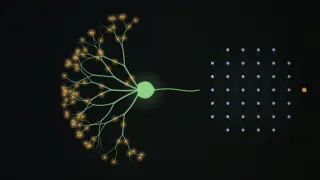
“Artificial neural networks work like the brain” is a common line. Artem Kirsanov's 2023 video argues that it gets the comparison backwards. A single biological neuron, thanks to its dendrites, is closer to a whole deep network than to one artificial unit (Kirsanov, 2023). This post follows the video, which is embedded below, and the two papers at its centre. The timestamps jump to the matching moment.
The neuron machine learning borrowed
Machine learning's neuron goes back to 1943, when Warren McCulloch and Walter Pitts described a model nerve cell as a summator and comparator: it multiplies its inputs by weights, adds them up and outputs 1 if the total crosses a threshold (McCulloch & Pitts, 1943; watch from 1:21). Connect enough of these units, adjust the weights, and you have a neural network. From there, the video notes, machine learning and neurobiology largely parted ways, while the word “neuron” stayed (watch from 2:39).
The output side of that model is reasonable. Neurons are electrically excitable, and at the start of the axon voltage-gated sodium channels produce an all-or-none action potential, a genuine threshold (watch from 3:55; 5:10). The problem, Kirsanov argues, is the inputs (watch from 6:25).
Dendrites are not passive cables
The textbook picture treats dendrites as leaky cables. Synaptic inputs depolarise the membrane, the signal fades as it travels, and the soma adds everything up. Each input's weight depends on its receptors and its distance from the cell body: exactly the perceptron's weighted sum (watch from 7:44).
Real dendrites are covered in voltage-gated channels that make them active processors (watch from 8:59):
Sodium channels let action potentials travel backwards into the dendrites, which matters for synaptic plasticity, and they generate small local spikes that amplify inputs.
NMDA receptors open only when there is both neurotransmitter and enough depolarisation, so they act as coincidence detectors. The resulting NMDA spikes last hundreds of milliseconds and make dendritic integration non-linear (watch from 10:15).
That non-linearity has consequences. A cortical pyramidal neuron's dendrite can tell the order and speed of its inputs apart, responding differently to the same synapses activated in one direction or the other, so a single cell can be selective for temporal sequences (watch from 11:31).
A dendrite that computes XOR
The centrepiece is a 2020 study from Matthew Larkum's lab. Recording from the cell body and the dendrites of human layer 2/3 cortical neurons at the same time, Albert Gidon and colleagues found a new kind of event: a dendritic calcium action potential, not described in other mammals (Gidon et al., 2020; watch from 11:31). Its unusual property is selectivity for input strength. Too weak an input produces no spike, but so does too strong an input; only a middle range triggers one (watch from 12:51).
Kirsanov explains why that matters with logic gates. AND and OR are linearly separable: a single line can split the true outputs from the false ones, so one perceptron can compute either (watch from 14:06; 16:37). Exclusive OR, true when exactly one input is true, is not. No line separates its outputs, which is why XOR classically needs a network with a hidden layer (watch from 15:21).
The human dendrite does it alone. Activate one group of synapses and the dendrite spikes. Activate the other group and it spikes. Activate both and the input is too strong, so it stays silent. That is XOR, computed inside one branch of one neuron (watch from 17:55). The exact mechanism is still open, but simulations suggest a combination of known calcium channels and potassium channels sensitive to both voltage and calcium.
How deep is a neuron?
If single neurons are this capable, how do they compare with the networks named after them? A 2021 paper by David Beniaguev, Idan Segev and Michael London asked exactly that (Beniaguev et al., 2021; watch from 19:11). They built a detailed, biophysically realistic model of a cortical neuron, fed it streams of synaptic input, and trained deep convolutional networks to predict its output from the same inputs (watch from 20:28).
The results:
Five to eight layers were needed to predict the neuron's spikes and voltage accurately.
Remove the NMDA receptors and a network with a single hidden layer was enough, which shows how much of a neuron's complexity comes from dendritic non-linearity.
The network generalised. Trained on randomly scattered inputs, it still predicted the neuron's response to clustered, synchronous inputs it had never seen.
It was much faster. The eight-layer network ran about 2,000 times faster than solving the detailed model's equations (watch from 21:47).
What it means for brain-inspired computing
The video's conclusion is that neuroscience and deep learning should borrow more from each other, not less (watch from 24:17). For neuromorphic engineering, the message is sharper. If the unit of biological computation is closer to a small deep network than to a single weighted sum, then counting neurons understates the brain's capacity. Copying the brain will mean giving artificial neurons active, non-linear, branch-level computation, not only more of them.
References
Beniaguev, D., Segev, I., & London, M. (2021). Single cortical neurons as deep artificial neural networks. Neuron, 109(17), 2727–2739.e3. https://doi.org/10.1016/j.neuron.2021.07.002
Gidon, A., Zolnik, T. A., Fidzinski, P., Bolduan, F., Papoutsi, A., Poirazi, P., Holtkamp, M., Vida, I., & Larkum, M. E. (2020). Dendritic action potentials and computation in human layer 2/3 cortical neurons. Science, 367(6473), 83–87. https://doi.org/10.1126/science.aax6239
Kirsanov, A. (2023, January 29). Dendrites: Why biological neurons are deep neural networks [Video]. YouTube. https://www.youtube.com/watch?v=hmtQPrH-gC4
McCulloch, W. S., & Pitts, W. (1943). A logical calculus of the ideas immanent in nervous activity. The Bulletin of Mathematical Biophysics, 5(4), 115–133. https://doi.org/10.1007/BF02478259