
Military & AI
Palantir Gotham, Paused and Explained: Cyberfam on Palantir's Notional Defence Demo
Cyberfam's 2021 commentary pauses Palantir's five-minute Gotham demo, a notional South China Sea scenario, to explain what might be happening underneath. What the demo shows, what the commentary gets right, where it is guessing, and what deserves a harder look.
 Akmal Alif · 10 October 2026 MYT
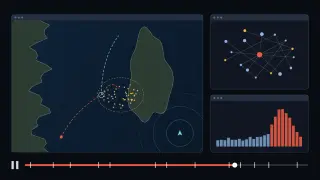
This is the third of three posts on Palantir Gotham. The first revisits a Harvard Business School student's case on the company. The second reads what Palantir tells UK government buyers in writing. This one watches the product in motion.
In June 2021 Palantir posted a five-minute video, Palantir Gotham for Defense Decision Making, which it describes as a notional demo (Palantir, 2021). In November 2021 the YouTube channel Cyberfam published a 22-minute commentary on it: the demo plays in full, paused every minute or so for a technical reading of what might be happening underneath (Cyberfam, 2021).
The host says at the start that they have no access to Gotham and are judging only from Palantir's presentation (watch from 0:00). Near the end, they say they are a Palantir investor and "bullish" on the company (watch from 19:00; 22:00). We keep both in mind below. The timestamps jump to the matching moment.
The demo's scenario
Palantir's own video is embedded here for reference. Everything in it is a staged scenario, and the demo says so. The timestamps below point into Cyberfam's video, which plays the demo in full.
A Palantir deployment strategist and former US Air Force officer narrates. After twenty years focused on counter-insurgency, the narrator says, the focus is shifting to great-power competition (watch from 2:20; 3:20). Then the scenario unfolds:
Detection. During a notional Chinese military exercise in the South China Sea, AI models running on satellite data detect increased military activity (watch from 3:40; 4:00).
A pattern. Ship-detection models find a build-up of fishing vessels around a major Taiwanese port. An activity model notices that many are tied together, which suggests the risk of a blockade (watch from 5:40).
An allied alert. Japanese intelligence reports that a Chinese destroyer has gone dark. AI models confirm it is missing from its southern base (watch from 6:40).
Prediction. Gotham fuses sources to project the ship's likely paths, and analysts pick a key fork to watch (watch from 10:20).
Tasking. Satellite coverage alone is not enough, so the system recommends alternatives. The best is an unmanned aircraft from Okinawa. Analysts load "micro models" to avoid threats and to detect military equipment and ships (watch from 10:40; 11:00).
Confirmation. Live video streams back. A ship-identification model estimates the destroyer's dimensions, speed and weapons, and an analyst verifies the detection (watch from 16:20).
Decision. The commander compares courses of action, some human-made and some machine-generated, that were tested in past exercises. Reinforcements would be too slow. A manned flight over the vessels would add risk. A freedom-of-navigation operation, moving an American or allied ship closer, scores the highest chance of success at the lowest risk. A task order goes out, the blockade disperses and the destroyer sails on (watch from 16:40; 17:20).
The demo closes by repeating that the example was notional and pitching Gotham as a way to make decisions at speed (watch from 17:40).
Three points the commentary gets right
Gotham came first, and the commercial products grew out of it. Cyberfam argues that Gotham was built for government customers before Palantir moved into the commercial market. The underlying platform carries over, which is why Foundry and Apollo look related to it (watch from 0:40; 20:00). This matches the three-platform picture in the HBS case. It also matches Palantir's G-Cloud document, which says Gotham builds on Foundry.
People stay in the loop. The host stresses that the system is not fully automated. An analyst sits behind the screen, and the software offers options rather than acting alone (watch from 13:20). The demo bears that out: an analyst verifies the AI detection and a commander chooses the course of action. Palantir's service definition describes the same pattern for its Video application. AI detections are shown to analysts, who confirm or dismiss them, and that feedback is used to improve the models.
The product is the integration. Cyberfam's main point is that the interface is a wrapper over many connected systems: satellites, allied intelligence feeds, aircraft and ships (watch from 15:00; 21:40). That is also how Palantir sells Gotham in writing: one data foundation, federated sources and open APIs.
Where it is guessing
Several explanations are the host's speculation, not something the demo shows. Cyberfam presents them as guesses:
Imagery cadence. The idea that satellites photograph an area every fifteen seconds to a few minutes, and that this stream trains the models (watch from 4:20; 5:00). The demo says only that models run on satellite data.
Rule engine. An "incident-based" design: tag metadata, store it, run rules such as "in this region and this size, so classify it as a naval vessel and flag it" (watch from 8:00; 9:00). It is a reasonable pattern, but the demo does not show it.
Tasking speed. That the drone tasking travels through APIs and many secured network hops, with acknowledgements, in "under a few minutes" (watch from 15:20; 16:00).
Exclusivity. That Palantir is among the few companies allowed to work in this space (watch from 14:00). This is opinion.
What deserves a harder look
The risk numbers. The host pauses on the course-of-action screen, which shows feasibility, estimated time and a risk score for each option (watch from 18:40; 19:40). The commentary treats them as impressive. The obvious questions go unasked: how is "probability of success" calculated, how was it validated, and how much should a commander trust it? A notional demo cannot answer them.
The choice of ending. The scenario resolves with a freedom-of-navigation operation, a show of presence rather than force. Palantir's G-Cloud document says that applications for targeting and fires are not described publicly. The public material shows the non-lethal end of the workflow on purpose.
Values. At 18:20 the host picks up the demo's closing line about protecting "our values". They note Palantir's refusal to sell to countries it does not consider allies. They support that policy, while saying they have voiced concerns about it before. Who decides who counts as an ally is the question at the centre of the first post.
How to watch it
Watch it as an enthusiast investor's walkthrough of a marketing demo. The pauses are useful, because Palantir's five minutes move fast and the screens are dense. The technical explanations are educated guesses. The video is also from 2021, and Palantir's products have changed since. For what the company commits to in writing, read the G-Cloud post.
Also in this series
Software That Saves and Takes Lives: An HBS Student's Palantir Case, Four Years On
What Palantir Tells UK Government Buyers About Gotham: Reading the G-Cloud 14 Service Definition
References
Cyberfam. (2021, November 16). Palantir Gotham: Let's get technical (PLTR) [Video]. YouTube. https://www.youtube.com/watch?v=HJ_6oiQqVeo
Palantir. (2021, June 8). Palantir Gotham for defense decision making [Video]. YouTube. https://www.youtube.com/watch?v=rxKghrZU5w8
Palantir Technologies UK. (2024). Palantir Platform: Gotham. Service definition document [Prepared for the G-Cloud 14 framework]. Digital Marketplace. https://assets.applytosupply.digitalmarketplace.service.gov.uk/g-cloud-14/documents/92736/801146272055049-service-definition-document-2024-05-02-1537.pdf