
Neuromorphic
The Critical Brain: Why Neural Networks May Run at the Edge of a Phase Transition
Following Artem Kirsanov, the critical brain hypothesis from first principles: phase transitions, the Ising model, power laws, neuronal avalanches and the branching ratio, and why balancing excitation and inhibition may maximise information transmission.
 Akmal Alif · 8 October 2026 MYT
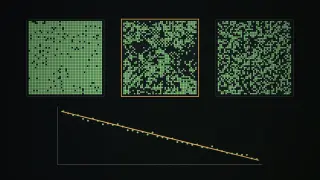
Neuroscience has no equivalent of Maxwell's equations, no compact theory of what the nervous system does in general. One candidate idea has gathered growing evidence: the critical brain hypothesis, which says that networks of neurons operate near the point of a phase transition, balanced between order and disorder. Artem Kirsanov, a neuroscience PhD student at Harvard, builds the idea from first principles in a 2023 video (Kirsanov, 2023), embedded below. This post follows it, and the timestamps jump to the matching moment.
Phase transitions, from water to magnets
The video starts with boiling water. At 100 °C, added heat stops raising the temperature and goes into breaking bonds between molecules. The molecules are unchanged, but the system's large-scale properties switch from liquid to gas (watch from 1:31).
Two terms do most of the work. A control parameter, such as temperature, is what you vary. An order parameter is a large-scale property that responds and measures how organised the system is. Boiling is a first-order transition: the order parameter jumps. In a second-order transition it changes continuously, which lets the system sit at a special in-between state, the critical point, where new properties emerge (watch from 3:01).
To build intuition, Kirsanov uses the Ising model of a magnet: a lattice of spins, each +1 or −1, that prefer to align with their neighbours while temperature shakes them randomly (watch from 4:31; 6:03). Cold, the spins line up and the lattice is magnetic. Hot, they point every which way. In between, at the critical temperature, order and disorder are exactly balanced (watch from 7:34).
What is special about the critical point
Two properties emerge there.
Long-range communication from local rules. Each spin only interacts with its neighbours, yet a flip can ripple across the whole lattice. Kirsanov measures this with dynamic correlation: how coordinated two sites' fluctuations are over time. Cold spins barely move; hot spins move at random. At the critical temperature they fluctuate and stay coordinated, and the correlation length, the distance over which sites still move together, peaks sharply (watch from 9:04; 10:35; 12:06). The brain analogy is a network whose neurons communicate most effectively across the most synapses.
No characteristic scale. Zoom in or out on the critical lattice and it looks the same, like a fractal (watch from 13:38). Kirsanov makes this precise with a thought experiment: shrunk to an unknown size, you measure cluster sizes and find that doubling a cluster's size always cuts its probability by the same factor. The only function with that property is a power law, f(x) = a·x^(−γ), which appears as a straight line on a log–log plot (watch from 15:09; 18:10). Many quantities follow power laws near a critical point, so finding them is a hint that a system sits near a second-order transition (watch from 19:42).
Neuronal avalanches
The first strong evidence that the brain might be critical came in 2003. John Beggs and Dietmar Plenz grew slices of rat cortex on an 8 × 8 grid of electrodes and recorded spontaneous activity (Beggs & Plenz, 2003; watch from 19:42). Treating sharp dips in the local field potential as discrete events, they saw quiet periods broken by cascades of activity that spread, reverberated and died out: neuronal avalanches, named after sandpiles and earthquakes (watch from 21:12).
Defining an avalanche as a run of active time bins between quiet ones, they found that avalanche sizes and durations followed power laws: no characteristic scale, the signature of a critical point (watch from 22:42). Similar avalanches have since been reported in awake animals of many species, including worms, zebrafish, monkeys and humans, and at scales from single neurons to EEG (watch from 24:14).
The branching ratio
What would temperature and magnetisation be for a brain? Kirsanov answers with a simplified branching model: layers of neurons where each connection passes a spike on with some probability (watch from 25:45). The control parameter is the branching ratio σ, the sum of a neuron's outgoing transmission probabilities, which equals the average number of neurons each active neuron goes on to activate (watch from 27:16).
σ = 0.5: activity dies out quickly, like a deep coma.
σ = 2: activity explodes, like epilepsy.
σ = 1: each neuron activates one other on average, activity is sustained, and avalanche sizes and durations follow power laws (watch from 28:48).
In real cortex, the branching ratio is set by the balance of excitation and inhibition. That balance can be manipulated: drugs that block inhibition push networks into supercritical activity, and drugs that block excitation make them subcritical, and both break the power laws (watch from 30:19).
Why the brain would want to be critical
The payoff is information processing. Kirsanov frames it as a guessing game: activate some neurons in the first layer and try to infer how many from the last layer. Subcritical networks erase the signal; supercritical ones saturate whatever the input. At σ = 1 the output best reflects the input, so information transmission peaks, just as correlation length peaked in the magnet (watch from 31:52). Experiments point the same way: cortex near criticality shows maximal dynamic range, information transmission and capacity (Shew & Plenz, 2013).
The video is candid that this is a young field. It leaves out universality classes, the theory of the critical exponents and how the brain keeps itself near criticality, and it recommends John Beggs's 2022 book The Cortex and the Critical Point for those (watch from 33:23).
Why it matters for neuromorphic computing
For anyone building brain-inspired hardware, criticality is a design principle as much as a biological curiosity. A spiking system tuned too quiet loses signals, and one tuned too excitable floods with them. The balance point is where a network transmits most, and real cortex appears to regulate itself to stay there. That is a target that neuromorphic chips and spiking networks can measure and aim for.
References
Beggs, J. M., & Plenz, D. (2003). Neuronal avalanches in neocortical circuits. The Journal of Neuroscience, 23(35), 11167–11177. https://doi.org/10.1523/JNEUROSCI.23-35-11167.2003
Kirsanov, A. (2023, March 5). Brain criticality – Optimizing neural computations [Video]. YouTube. https://www.youtube.com/watch?v=vwLb3XlPCB4
Shew, W. L., & Plenz, D. (2013). The functional benefits of criticality in the cortex. The Neuroscientist, 19(1), 88–100. https://doi.org/10.1177/1073858412445487