AI Builders
Bill Gates on the Turbulent AI Era: Three Risks, Real Upside and a Plan Nobody Has Yet
Bill Gates's video and Gates Notes memo on the turbulent AI era: why this time is different, three big risks for jobs, security and childhood, the upside in health, farming and education, and three proposals, including Human Reserved work and a tax on AI tokens and robots.
 Akmal Alif · 8 October 2026 MYT
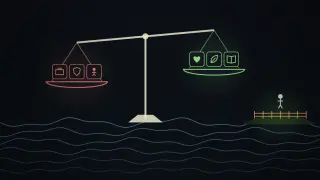
On 26 August 2026 Bill Gates published a short video and a long memo with the same message: AI is arriving faster than the world is preparing for it (Gates, 2026a, 2026b). The video is under two minutes and makes the case in broad strokes. The memo on Gates Notes sets out the risks, the benefits and three concrete proposals. This post covers both. The video is embedded below, and the timestamps jump to the matching line.
The claim: equalizer or injustice
Gates opens the video by calling AI both the most powerful tool for advancing equity and the greatest threat to it that humans have invented (watch from 0:00). Because AI can replace and even exceed human cognition, the transition will be one of the most turbulent eras in history (watch from 0:15).
The memo explains why Gates thinks commentators underestimate the change (Gates, 2026b):
Reliability is being fixed. Models that recently stumbled on Sudoku puzzles, or on counting the letters in “strawberry”, are learning to check their own work.
Past analogies mislead. The PC took about twenty years to change work, because software, prices and skills all had to catch up. AI runs on devices people already own, speaks natural language and adapts to people rather than the other way round.
The pace is different. The shift from farm to office work took generations. Gates expects AI to reach law, customer service, medicine, software and manufacturing within about a decade.
Gates also discloses a potential bias up front. Gates still has financial ties to the technology industry and works with AI companies as chair of the Gates Foundation, while stating that any investment profits go to the foundation. Readers, the memo says, should judge for themselves.
Three big risks
The video names them in quick succession (watch from 0:15; 0:30), and the memo expands each one (Gates, 2026b).
Jobs that do not come back. White-collar work goes first, with entry- and mid-level roles most exposed. Customer support, software engineering and paralegal work are early, followed by tasks like assessing loans, analysing data and triaging patients. Robots follow; Gates expects “smart” robots to compete in construction and hospitality by the end of the decade. Competition then creates a vicious cycle: once one company cuts costs with AI, its rivals must follow. Gates is especially worried about young people entering a workforce with fewer entry-level openings.
More power to do harm. AI lowers the skill needed for bioweapons, cyberattacks, fraud, deepfakes and surveillance. Gates notes that the capability that finds a software flaw for defenders also finds it for attackers. AI also concentrates power where it already sits, and the models themselves could act against human interests.
Childhood and relationships. AI companions that never push back could become a “protected greenhouse” for young people. Gates borrows the image from Jonathan Haidt and cites a Stanford and Carnegie Mellon study of more than 1,100 companion users, in which heavier, more personal use went with feeling worse. A preliminary survey also linked heavier AI use to weaker critical thinking, especially in younger people.
The upside is just as real
Then the video turns: the good could be amazing, from clean energy and climate to food, disease and education (watch from 0:30; 0:45). The memo grounds this in specifics (Gates, 2026b):
Health care. Stroke detection software is already used in nearly 2,000 US hospitals.
Farming. Better advice for farmers in low-income countries is where Gates expects the fastest impact.
Public services. AI can make health insurance, student aid and food assistance forms far easier to complete.
Education. Tutoring can preserve the “productive struggle” that builds understanding, explaining first and holding answers back later.
Gates insists the operative word is “can”. None of this reaches people automatically, and maximising the benefits matters as much as minimising the harms, because public trust depends on people seeing AI make their lives easier before it takes their jobs.
The plan nobody has yet
The worry at the centre of the video is that there is no plan, “and not even a plan to have a plan” (watch from 1:00). Gates argues AI companies should not lead this, and that solutions belong to a democratic process (Gates, 2026b). The memo offers three starting points:
New institutions for the transition. Nationally, each country needs bodies that can set priorities across agencies, so no AI risk falls between departments. Internationally, Gates calls for a new organisation that borrows from nuclear inspections, aviation rules and the ozone agreements, and that will need some US–China cooperation.
“Human Reserved” work. Some jobs could be set aside for people, the way nature reserves set aside land. Reasons might be economic, such as protecting workers who cannot easily retrain, or human, such as delivering a terminal diagnosis. Gates connects the idea to the paid caregivers who looked after Gates's father through Alzheimer's.
Taxing AI tokens and robots. Today, payroll is taxed while machines are written off as expenses, which nudges employers toward replacing people. A targeted tax would slow that a little and fund retraining and a stronger safety net.
The video closes on the same appeal as the memo: act now, before unemployment rises sharply and public trust erodes, with a response in every country and globally (watch from 1:15; 1:30).
For people building with AI
Most of the memo is aimed at governments, but a few points apply directly to builders:
Productive struggle. Design learning tools that withhold answers when the point is learning.
A human in charge. Keep a person in charge where the moment is human, such as care and bad news.
Disclosed interests. State your interests when you argue about the technology, as Gates does.
Two questions. Ask who benefits and who is displaced before shipping, not after.
References
Gates, B. (2026a, August 26). The turbulent era of artificial intelligence is here [Video]. YouTube. https://www.youtube.com/watch?v=MLeTQWQiOvg
Gates, B. (2026b, August 26). The turbulent AI era is here. The choices we make now are critical. Gates Notes. https://www.gatesnotes.com/work/make-ai-work-for-everyone/reader/a-turbulent-ai-era-and-critical-choices-to-make